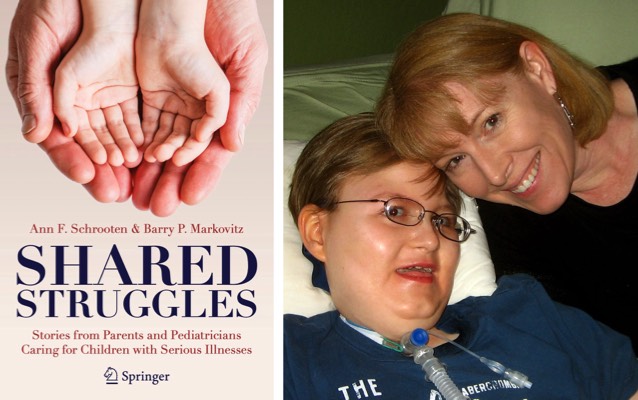
Shared Struggles is based on the book by Ann Schrooten and Barry Markovitz, MD MPH:
Shared Struggles: Stories from Parents and Pediatricians
Caring for Children with Serious Illnesses
The book is a compilation of stories from parents and physicians,
highlighting hope, communication, compassion and trust in navigating complex pediatric care.
Shared Struggles is based on the book by Ann Schrooten and Barry Markovitz, MD MPH:
Shared Struggles: Stories from Parents
and Pediatricians Caring for Children
with Serious Illnesses.
The book is a compilation of stories from parents and physicians, highlighting hope, communication, compassion and trust in navigating complex pediatric care.
My son, Jack, was born on a cold November morning in 1998. Jack made his entrance into this world 7 weeks early. After a mostly uneventful stay, Jack left the NICU six weeks after he was born accompanied by an oxygen tank and pulse oximeter. He joined his two older sisters at home and our family of five settled in, expecting Jack’s need for supplemental oxygen to be short-lived. They told us that he just needed time to grow.
A month after he was discharged from the NICU, Jack had an apneic event at home (and yes, rescue breaths really do rescue.) Jack was admitted to the pediatric intensive care unit at St. Louis Children’s Hospital. After several surgeries, multiple failed attempts at extubation, and an inconclusive muscle biopsy, Jack was discharged from the PICU six months later with a trach, g-tube and connected to a ventilator to assist with his breathing. Prior to discharge, I was told I needed to choose a pulmonologist to follow Jack on his ventilator. Not being enamored with any of the pulmonologist I encountered during Jack’s PICU stay, and finding out that a highly recommended pulmonologist at another hospital was not taking new patients, I was at a loss for who was going to manage Jack’s ventilator. I think in an effort to get us out of there (I say, half-jokingly), one of the PICU intensivists, Dr. Barry Markovitz, offered to take on the unconventional role of managing Jack’s ventilator on an outpatient basis, along with a critical care fellow he recruited to help.
When Jack was 3 years old, our family moved from St. Louis to Phoenix, yet, despite the break in the doctor-patient relationship, Barry and I kept in touch over the course of Jack’s life. I often sought out Barry’s advice and reason when it came to Jack’s care and Barry always listened and helped in any way he could.
Jack was eventually diagnosed with a rare congenital muscular dystrophy, and in 2014, at the age of 15, Jack died from complications of his disease.
Shortly after Jack died, Barry and I partnered to write a book together. We recognized that the connection we had and what we learned from each other needed to be shared and the conversation needed to be expanded to include other parents and doctors. We reached out to our respective networks of parents and colleagues for stories that shared an interaction or relationship with a physician or parent that had a significant impact on them. The response we received was overwhelmingly positive and supportive and, as a result, Shared Struggles came to be.
While working on Shared Struggles, I was in awe of the selflessness of the parents and physicians (many of whom did not even know me) who took time out of their busy lives to write a story for the book. I was deeply touched by their willingness to share such personal, and sometimes heartbreaking, stories, and by their enthusiasm for the need for a book like Shared Struggles. The prevailing messages that came through in this book are that parents are relentless advocates for their children and will do whatever it takes to make sure their child receives the best and most compassionate care possible, and that the physicians who care for our children truly do care and they are profoundly changed through their experiences in caring for our children.
Shared Struggles was written over the course of six years, but its roots were planted over twenty years ago in a pediatric intensive unit when a little boy named Jack and his mom met a truly special doctor. As I hold the book in my hands and read the words on the back cover that say I am “the parent of a child born with a chronic complex condition who has more than 15 years of experience interacting with pediatric subspecialists and other healthcare professionals who cared for her son”, it sounds so foreign to me after so many years of being away from “the life.” In editing the stories and writing the commentaries, there were many times I questioned my authority to have any say in the stories and experiences shared. Yet, when I gave myself some grace, the words flowed. Because I do understand the experiences shared, and I also understand that this book is more than just an opportunity to bring parents and physicians together, it is an extension of why I was given Jack and why I was given the connections he brought to me and why I was given the lessons I learned as his mom. Shared Struggles is not my book, it is a collective effort, and will always be “our” book. But it is also Jack’s legacy and a reckoning for me of the why of all the hard that came with being Jack’s mom. The opportunity for this book came because Jack lived AND because Jack died. The price was high (too high), but to be given the opportunity to find the good in the hard is a gift I will always be grateful for.
A month after he was discharged from the NICU, Jack had an apneic event at home (and yes, rescue breaths really do rescue.) Jack was admitted to the pediatric intensive care unit at St. Louis Children’s Hospital. After several surgeries, multiple failed attempts at extubation, and an inconclusive muscle biopsy, Jack was discharged from the PICU six months later with a trach, g-tube and connected to a ventilator to assist with his breathing. Prior to discharge, I was told I needed to choose a pulmonologist to follow Jack on his ventilator. Not being enamored with any of the pulmonologist I encountered during Jack’s PICU stay, and finding out that a highly recommended pulmonologist at another hospital was not taking new patients, I was at a loss for who was going to manage Jack’s ventilator. I think in an effort to get us out of there (I say, half-jokingly), one of the PICU intensivists, Dr. Barry Markovitz, offered to take on the unconventional role of managing Jack’s ventilator on an outpatient basis, along with a critical care fellow he recruited to help.
When Jack was 3 years old, our family moved from St. Louis to Phoenix, yet, despite the break in the doctor-patient relationship, Barry and I kept in touch over the course of Jack’s life. I often sought out Barry’s advice and reason when it came to Jack’s care and Barry always listened and helped in any way he could.
Jack was eventually diagnosed with a rare congenital muscular dystrophy, and in 2014, at the age of 15, Jack died from complications of his disease.
Shortly after Jack died, Barry and I partnered to write a book together. We recognized that the connection we had and what we learned from each other needed to be shared and the conversation needed to be expanded to include other parents and doctors. We reached out to our respective networks of parents and colleagues for stories that shared an interaction or relationship with a physician or parent that had a significant impact on them. The response we received was overwhelmingly positive and supportive and, as a result, Shared Struggles came to be.
While working on Shared Struggles, I was in awe of the selflessness of the parents and physicians (many of whom did not even know me) who took time out of their busy lives to write a story for the book. I was deeply touched by their willingness to share such personal, and sometimes heartbreaking, stories, and by their enthusiasm for the need for a book like Shared Struggles. The prevailing messages that came through in this book are that parents are relentless advocates for their children and will do whatever it takes to make sure their child receives the best and most compassionate care possible, and that the physicians who care for our children truly do care and they are profoundly changed through their experiences in caring for our children.
Shared Struggles was written over the course of six years, but its roots were planted over twenty years ago in a pediatric intensive unit when a little boy named Jack and his mom met a truly special doctor. As I hold the book in my hands and read the words on the back cover that say I am “the parent of a child born with a chronic complex condition who has more than 15 years of experience interacting with pediatric subspecialists and other healthcare professionals who cared for her son”, it sounds so foreign to me after so many years of being away from “the life.” In editing the stories and writing the commentaries, there were many times I questioned my authority to have any say in the stories and experiences shared. Yet, when I gave myself some grace, the words flowed. Because I do understand the experiences shared, and I also understand that this book is more than just an opportunity to bring parents and physicians together, it is an extension of why I was given Jack and why I was given the connections he brought to me and why I was given the lessons I learned as his mom. Shared Struggles is not my book, it is a collective effort, and will always be “our” book. But it is also Jack’s legacy and a reckoning for me of the why of all the hard that came with being Jack’s mom. The opportunity for this book came because Jack lived AND because Jack died. The price was high (too high), but to be given the opportunity to find the good in the hard is a gift I will always be grateful for.
- Ann F. Schrooten